Thinkers Draw the Map. Doers Change the Terrain
(VERSION ESPAÑOL) Los Thinkers construyen el mapa. Los Doers cambian el terreno.
The image alone is not striking
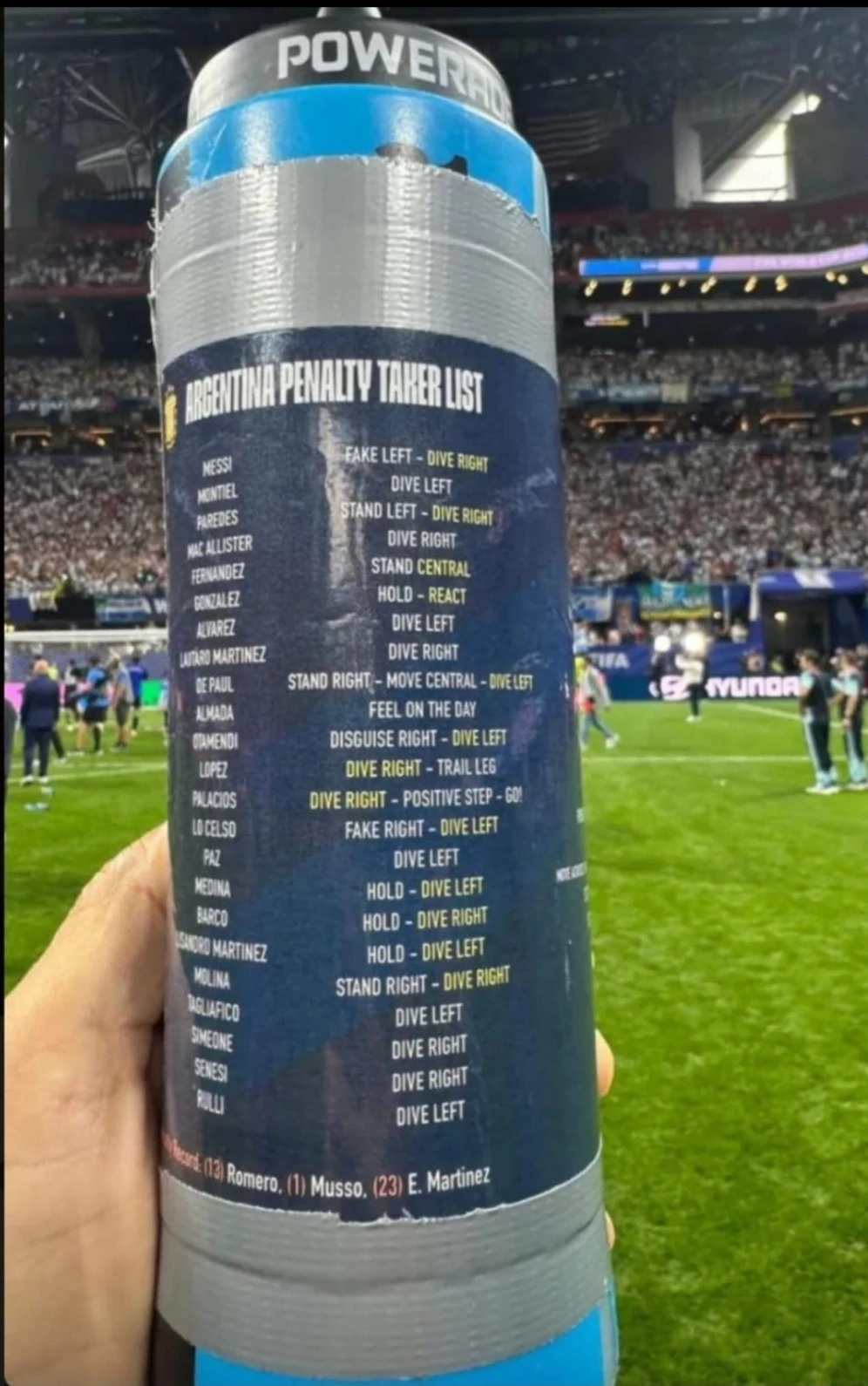
A blue bottle, wrapped in gray tape, accompanies England goalkeeper Jordan Pickford. Printed on it is a detailed list of Argentina's potential penalty takers—Messi, Mac Allister, Enzo Fernández, Lautaro Martínez, De Paul—each paired with precise instructions: Dive Right, Stand Central, Fake Left. It perfectly captures the spirit of our time.
.webp)
We've come to believe that the team with the most information has the greatest chance of winning. Never before have we had access to so much data. Never before have analysts, dashboards, artificial intelligence, and predictive models been so deeply embedded in preparation and decision-making.
Yet the 2026 World Cup semifinal between England and Argentina reminded us of an uncomfortable truth:
Information alone never wins the game.
Pickford's bottle represents hundreds of hours of analysis. Behind it are statisticians, performance analysts, psychologists, and probability models. All that knowledge fit onto a single water bottle.
But a World Cup semifinal is not won by possessing the best information. It is won by making the best decisions. At precisely the right moment.
Ironically, the decision that ultimately shaped England's fate wasn't written anywhere on that bottle. It was made on the bench.
England manager Thomas Tuchel chose to retreat nearly forty minutes before the final whistle. His team surrendered initiative, possession, and ultimately the emotional control of the match to an opponent that rarely needs a second invitation to take over.
That was a decision. And decisions matter more than the data that precedes them. This extends far beyond football.
For years, organizations admired the Thinkers: those who analyzed better, built more sophisticated models, and accumulated more information than everyone else. That era is changing.
Artificial intelligence has democratized knowledge. Data is becoming universally accessible. Analytical tools are no longer scarce. Thinking well remains essential—but it is no longer enough to create lasting competitive advantage.
What is truly scarce today is something else. The ability to decide.And to execute.
We are not witnessing the end of the Thinkers. We are entering an era where thinking alone is no longer sufficient.
The real advantage belongs to those who transform knowledge into action faster than everyone else. The Doers.
Tomorrow's winning organizations won't necessarily be those producing the best reports. They will be those turning those reports into timely, consistent, high-quality decisions.
Competitive advantage is no longer about knowing more. It is about doing more—with better judgment.
Pickford's bottle may have contained valuable information. But the match itself proved that victory depended on decisions made long after that information had been collected and analyzed. The same is true in business.
Many companies have excellent market intelligence, deep customer insights, and real-time dashboards. Yet they still lose opportunities because they delay the right decision—or hold on to strategies long after they have stopped working.
In a world where knowledge is increasingly available to everyone, the true differentiator is the ability to act. The next competitive advantage will not belong to those who possess more information, but to those who turn information into action before everyone else.
The future won't belong to organizations that know more. It will belong to those that execute better. That's precisely what I help leadership teams achieve: transforming strategy into execution and competitive advantage.
If you'd like to explore how your organization can move from thinking to doing, I'd be delighted to talk.
Raúl Bustamante, B.A.
Gestión Estratégica